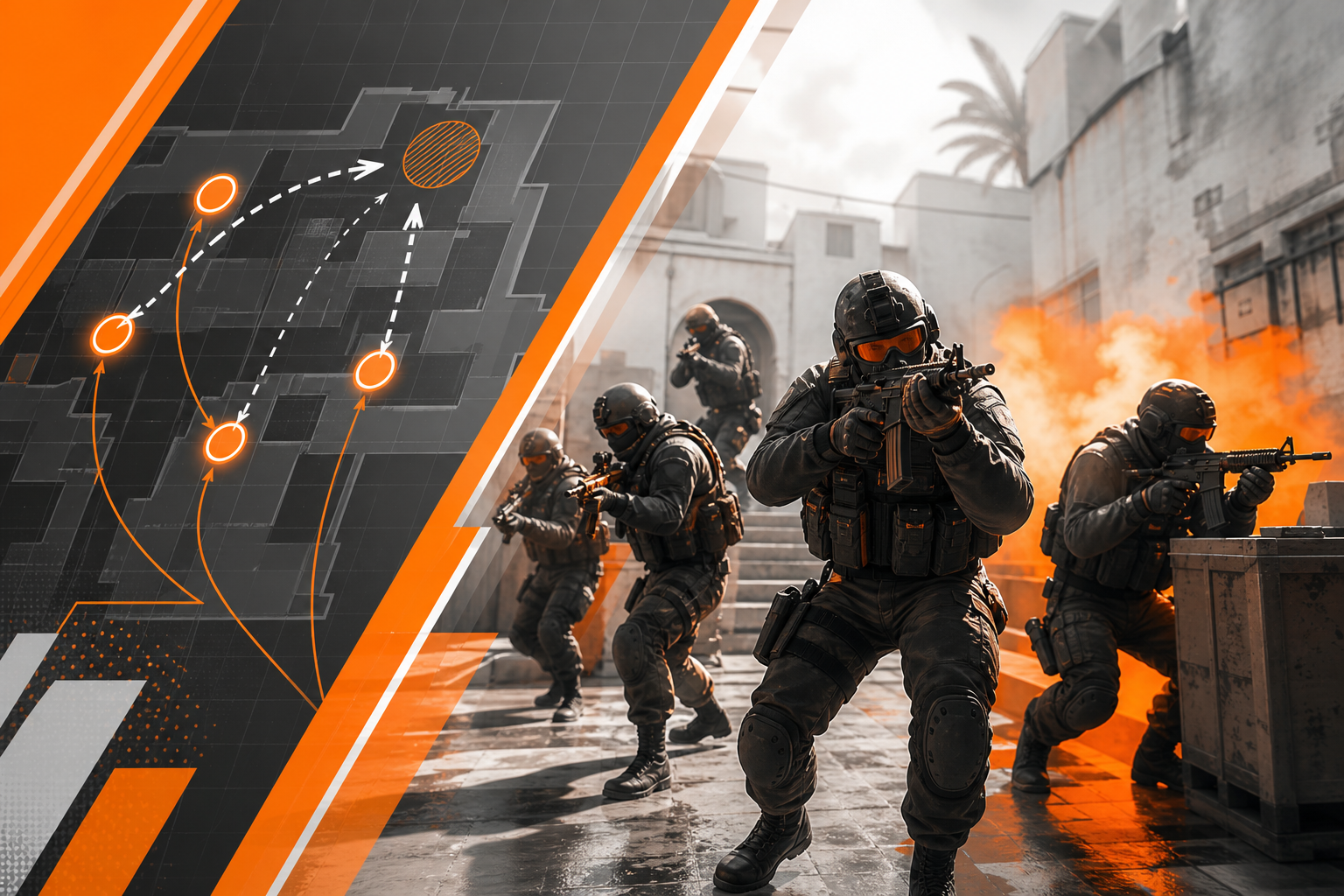
Five-player executes often lose their shape before the first fight is settled: one player arrives late, a second takes an unnecessary duel, and the team rotates without a shared trigger. Rush mode five-player executes can help address that problem by borrowing the mode’s compressed pace and repeatable objective pressure, then applying those habits to full-team practice.
CS2 Rush is an official queued 3v3 mode, not a five-player scrim or a substitute for map-specific tactical work. Its value is as a pressure drill: teams can rehearse concise calls, synchronized movement, fast post-fight decisions, and clear rotation rules under changing arena conditions. The goal is to carry over disciplined habits, not to assume that Rush’s maps, player count, or round structure reproduce a standard competitive execute.
How Rush mode can sharpen five-player executes
Rush compresses several useful tactical demands into short, objective-focused rounds. Valve introduced the mode as a fast-paced queued 3v3 experience across randomly selected battle arenas. Players push toward the opponent’s castle and control the tower to win rounds. The launch description also stresses making the most of limited budget and time to clear the objective.
Those conditions create a useful practice prompt for a five-player team: can every player understand the objective, move on the same signal, and make the next decision without waiting for a long tactical pause? In a standard execute, the answer depends on roles, utility, map geometry, and the opponent’s response. Rush does not recreate those details. It can, however, put a team into repeated situations where hesitation and unclear responsibility are immediately visible.
Direct answer: Use Rush to rehearse fast calls, coordinated movement, trade spacing, and explicit rotation triggers. Then validate those habits in five-player practice on the maps and rounds your team actually competes on; Rush’s 3v3 format and randomly selected arenas cannot replace that work.
The distinction matters. A 3v3 round has fewer players, different sightlines, and different ways to cover space than a five-player match. A team that simply tries to copy Rush movement into a full execute may overextend, leave a lane unguarded, or rotate too early. A better approach is to extract the transferable behaviors and assign a separate practice objective to each one.
- Call compression: communicate the immediate action and the condition that would change it.
- Arrival discipline: move together closely enough to support trades, without stacking every player into one line of fire.
- Decision ownership: make clear who calls the next step after an entry, a lost player, or a stalled push.
- Objective focus: keep the team’s movement tied to the round’s win condition rather than chasing an isolated duel.
These are practice principles, not claims that Rush automatically improves competitive results. The mode provides a fast, repeatable setting in which a team can notice whether its calls and reactions remain coherent under pressure. Coaches and players still need to interpret what happened and test any adjustment in the full format.
Build a Rush practice around one measurable team behavior
Rush can become noisy practice if a team enters with a vague goal such as “play faster.” Speed alone is not the same as execution. A useful session isolates one behavior, gives players a simple rule for acting on it, and reviews whether the rule made the team more coordinated. Since the arenas are randomly selected, the practice question should be about decisions that transfer across layouts rather than memorizing a route in one environment.
Choose the behavior before queueing
Pick a single focus for a block of play. It might be the time between the first call and the first coordinated movement, the quality of the team’s trade spacing, or the clarity of the call after a player is eliminated. Keep the target narrow enough that players can recognize it during the round.
For example, a team working on late arrivals can agree that no player starts a follow-up move until the caller confirms the group is ready. A team working on post-fight decisions can assign one player to state whether the group continues, pauses, or rotates after the first engagement. The precise wording can vary; the important part is that teammates know who owns the decision and what information they should provide.
Use a short, repeatable practice loop
- Set the focus. State one behavior to practice and one failure mode to watch for. Avoid adding unrelated goals during the same block.
- Agree on a trigger. Define what starts the action or changes it. A trigger should be observable to the whole team, such as a confirmed contact, a lost player, or the group reaching an agreed staging point.
- Play the round. Keep calls concise enough for teammates to act on them. If a player needs to explain a full plan during the engagement, the initial call may have lacked a clear default.
- Review the decision, not just the result. Ask whether the group moved together, whether the trigger was understood, and whether the next call came from the right player. A round result alone cannot tell you whether the process was sound.
- Change one thing at a time. If the group stalled, adjust the call, trigger, or responsibility before changing all three. This makes it easier to see which adjustment helped.
Random arena selection makes this loop more useful when the team treats each layout as a prompt to apply the same decision rule, not as a reason to improvise every role. Players can still adapt to the space, but they should preserve the basic communication contract. If every arena produces a different vocabulary, the practice may test map familiarity more than execution discipline.
Keep the review lightweight and specific
A coach does not need a complex analysis system to get value from the drill. A short note after a round can record the intended behavior, whether the trigger was called, and the first moment the team diverged. If available, a recording can help distinguish a communication failure from a mechanical mistake or a poor read of the situation.
Do not interpret every lost round as proof that the practice rule failed. Rush is designed around short rounds, and the outcome can be influenced by individual fights. Review the decision sequence: did the team understand the objective, arrive in support, respond to new information, and make a deliberate next move? That sequence is closer to the skill being trained than the score alone.
Turn Rush pace into reliable five-player call structure
Fast play creates a communication constraint: the team has less time to exchange context, but it still needs enough information to act together. The answer is not to remove useful calls. It is to structure them so that players can hear the action, the trigger, and the fallback without receiving a long explanation in the middle of a fight.
A practical call can follow three parts: action, condition, next decision. The action tells players what to do now. The condition describes what would stop or redirect that action. The next decision tells the team who will speak after the condition occurs. A team can adapt the language to its own terminology, but consistent structure reduces the chance that different players interpret the same call differently.
- Action: identify the immediate movement or objective, not a broad aspiration such as “take control.”
- Condition: name the information that matters, such as a confirmed contact, a blocked route, or a player being removed from the fight.
- Next decision: make it clear whether the caller retains control or hands the call to another player after the condition.
Rush’s objective framing is particularly useful here. The mode asks players to reach the opponent’s castle and control the tower, while Valve’s launch wording emphasizes pressure across battle arenas and the push-and-pull of the contest. For a five-player team, the transferable idea is to tie movement to an objective and its timing. A group should be able to answer not just “where are we going?” but “what are we trying to secure, and what event changes our plan?”
Use calls that survive a lost player
Teams often have a plan for the opening and a less consistent response when the first engagement changes the player count. Rush can be used to practice that transition. Before a round, agree on who calls the next action if the original caller is eliminated or cannot communicate. That backup should not have to reconstruct every detail; the team can use a default action and a simple condition for abandoning it.
This is not a demand for rigid scripts. The point is to make responsibility legible. If several players issue conflicting instructions at once, the group loses time deciding which call to follow. If no takes ownership, it may drift into separate duels. A primary caller and a defined backup create a clear decision path while leaving room for players to report immediate information.
For five-player executes, this discipline should be tested with the team’s actual roles. A Rush session can expose whether players wait for an explicit instruction when they should act on a shared trigger, or whether they make individual moves that the rest of the group cannot support. The follow-up practice should then use the real map and tactical setup, where roles and utility change what a good call looks like.
Train trade spacing and post-fight decisions, not just entry speed
Moving quickly is useful only when the team can support the move. Players who arrive too far apart may be unable to trade; players who bunch together may give an opponent a favorable opportunity to affect several teammates at once. Rush can make arrival and support habits visible because each player has to make quick decisions in a compact objective race. For five-player practice, the lesson is to measure whether movement preserves useful support, not whether the team simply reaches the fight sooner.
Define what “together” means in each drill
“Stay close” is not precise enough to evaluate. A more useful instruction identifies the relationship players need to preserve: the next player should be positioned to respond to a teammate’s engagement, while the rest of the group remains able to follow the call or hold a supporting angle. The exact spacing depends on the game space and the team’s roles, so Rush should be treated as a prompt to observe the relationship rather than as a fixed distance model.
In review, identify the first moment a teammate could no longer support the player a. Was the gap created by a late call, a player checking an unnecessary angle, or a deliberate split that was not communicated? Those explanations point to different corrections. A spacing problem is not always solved by telling everyone to move faster; the team may need a clearer signal, a different order of movement, or a better-defined role for the trailing player.
Make the post-fight choice explicit
After a fight, teams can lose time by treating the next action as self-evident. They may chase when they should stabilize, or pause when they need to secure the objective. Rush’s short, objective-centered structure provides a reason to rehearse that moment: once the engagement changes the situation, the caller should make the next decision explicit rather than assuming the group has the same read.
Silent reload adds another useful decision point. Valve introduced silent reload in the September 22, 2026 update: holding the reload key produces a quieter reload animation, but the animation is slower. The tradeoff is relevant to post-fight discipline because a player may need to weigh stealth against time. The right choice depends on the immediate situation; teams should not turn the mechanic into a universal rule that quiet reloading is always preferable.
Valve fixed silent-reload edge cases in the September 24 update, including an interaction involving tapping reload before holding it and a case where silent reload could make shotguns fire faster than normal. Those fixes show that the mechanic required attention, but they do not establish a single tactical answer for every weapon or fight. Use it as a discussion prompt: who is safe to reload, who is responsible for covering, and what information should trigger a move before the reload completes?
Practice question: After the first fight, can every player state the team’s next action, the reason for it, and who is covering the players who need time to reload or reposition?
Build rotation discipline with triggers, not guesses
A rotation is a team decision, not simply a response to movement elsewhere on the map. If players leave their positions on incomplete information, the team can surrender useful space without gaining a coordinated advantage. If they wait for certainty that never arrives, they can miss the moment to act. Rush can help teams rehearse fast responses to changing conditions, but the rotation rules should be designed for the actual five-player map and objective.
Start by writing down the information that should cause a rotation. A trigger might depend on confirmed contact, the loss of a player, a blocked route, or a change in the objective state. These are examples for team discussion, not universal rules. Each roster needs to decide which signals are reliable enough to move players and which should only prompt a check or a small adjustment.
Separate information from interpretation
During a fast round, players can mistake a guess for a confirmed fact. A concise call should distinguish what the player saw or heard from what the player believes it means. That distinction gives the caller room to act without presenting uncertain information as settled. It also helps teammates avoid rotating on an assumption that no one else can verify.
For example, a player can report a confirmed event, then offer a short interpretation. The caller can acknowledge the report and state whether the team is committing, holding, or gathering one more piece of information. This method takes practice: if every player offers a full theory at once, the communication channel becomes harder to use. Keep reports relevant to the next decision.
Give every rotation a destination and a stopping rule
A rotation call should identify where the group is moving and what it expects to achieve there. It should also include a stopping rule: what would make the team halt, return, or choose another route? Without that rule, a rotation can become a chain of improvised corrections, with each player moving according to a different interpretation of the original call.
Rush’s changing battle arenas can encourage adaptable thinking, but random selection is not a substitute for learning the competitive maps. A useful transfer exercise is to keep one rotation principle constant while changing the environment. For instance, the group can practice assigning a caller and backup, separating confirmed information from inference, and naming a stopping condition. Then the team should rehearse the same principle on the map where its actual rotations occur.
There is a trade-off between simple rules and detailed map knowledge. A general trigger is easy to remember under pressure, but it may be too broad for a specific round. A map-specific call can be more precise, but it requires the team to know the setup and to communicate the relevant detail quickly. Use Rush to practice the communication habit; use map sessions to refine the tactical content.
Account for Rush’s limits before transferring its lessons
Rush is best treated as a supplementary practice environment. Its queued 3v3 format, randomly selected battle arenas, objective, and round pacing differ from a standard five-player competitive match. Those differences are exactly why the mode can be useful for rapid decision reps, and also why teams should be careful about what they conclude from it.
- Player count changes coverage. Three players cannot represent five-player role assignments, utility sequences, or the same number of simultaneous threats. A clean 3v3 response may not scale directly to a full execute.
- Different arenas change geometry. Random selection encourages adaptation, but it does not teach the timings, angles, or site-specific decisions of the team’s competition maps.
- Objective rules change priorities. Reaching the castle and controlling the tower are not interchangeable with every competitive round condition. Preserve the general discipline of objective focus, not the mode’s exact route or timing.
- Short rounds can favor immediate choices. Competitive rounds may require slower information gathering, economy-aware decisions, utility coordination, or a late-round plan that Rush does not reproduce in the same way.
These limits do not make Rush irrelevant. They define the correct unit of transfer: communication, decision ownership, support timing, and response to new information. Do not treat a result in Rush as evidence that a five-player execute is ready. Treat it as a way to notice whether the team can act on a shared call and then verify the relevant tactic in the full environment.
Valve’s updates also show that the mode was being actively refined shortly after launch. On September 23, 2026, Valve increased the maximum countdown-after-elimination time from 7 seconds to 14 seconds on end rooms and Convoy, while reducing warmup, freeze time, and technical timeout time. On September 24, Valve added a clearer rules description to the loading screen and adjusted team-damage kick rules. That iteration is a reason to keep practice expectations flexible: mode behavior and timing can change, so teams should focus on robust habits rather than build a drill around an assumed permanent detail.
Audio and visual changes also matter when evaluating a practice round. The update made reloads quieter, removed the sound from unscoping sniper rifles, and increased the visual fidelity of bullet impact decals and blood. These changes can affect what players perceive and when they react. If a review depends on a sound cue or visual signal, establish what was actually available in the round rather than attributing every missed response to poor discipline.
Review execution quality with context, not only the result
A team can win a round after an uncoordinated push, or lose after making a sound decision that fails in the final engagement. Review should therefore separate process from outcome. Start with the calls and movements the team controlled: Was the initial instruction clear? Did players understand the trigger? Could the next player support the first engagement? Did the team choose a deliberate follow-up after the fight?
CS2’s evolving statistics and analysis tools can add context to that review. HLTV’s Rating 3.0 includes Round Swing, which measures the direct impact of each kill using map, side, and economy context. HLTV says its Round Swing credit is divided using final damage, damage share, flash assists, and whether the kill was a trade. Those elements align with questions an execute review should ask: did the team create value together, and did a trade or assist contribute to the round?
Use metrics as supporting evidence, not as a replacement for tactical review. A number can help identify a moment worth examining, but it cannot by itself explain whether a player should have rotated, whether the call was audible, or whether the team’s spacing matched the plan. The relevant question is not simply who had the strongest individual rating; it is whether the execute produced a useful round state for the team.
Use a review sequence that preserves context
- Reconstruct the call. Record what the caller intended and what teammates could reasonably understand at the time.
- Mark the first divergence. Identify where a player moved, paused, or took a fight outside the shared plan.
- Check contribution. Review trades, damage, assists, and the effect of the engagement on the round rather than counting kills in isolation.
- Account for the situation. Consider map, side, economy, and opponent context before judging whether the decision was valuable.
- Choose one correction. Translate the review into a specific change for the next practice, then test it again.
HLTV has also argued in its April 2026 analysis of fixture difficulty that rating is a conversation starter, not the full story, because opposition quality and context matter. That principle applies to practice review too. A team should not use a single Rush result or a single performance figure to make a broad claim about execution quality. The useful evidence is a pattern of decisions, viewed in the conditions that produced them.
Map investment matters as well. Valve’s Premier map-selection changes introduced a 1-2-1 pick structure, and HLTV described the change as rewarding time spent developing strategies on specific maps. That is a reminder to keep general coordination drills and map preparation connected but distinct. Rush can reinforce habits that support a prepared playbook; the playbook itself still needs deliberate work on the maps the team expects to play.
Fit Rush drills into a complete five-player practice plan
Rush is most useful when it fills a defined gap in a broader training plan. It can provide short rounds for rehearsing communication and reaction discipline, while scrims and map sessions test whether those habits survive the real tactical demands of five-player Counter-Strike. A team should decide where the mode fits based on its current problem, not because the mode is new or fast.
When to use it
Use Rush when the team needs repeated opportunities to practice quick calls, shared movement, post-fight choices, or reactions to changing information. It can also be useful when players need to identify whether a communication habit is consistent across changing spaces. The mode’s randomly selected arenas mean that teams cannot rely on a single memorized layout, which encourages attention to the decision process.
Consider a different practice method when the main problem is specific to a competitive map, utility timing, economy management, role assignment, or a carefully prepared five-player sequence. Those problems require a setting that reproduces the relevant constraints. A fast 3v3 mode may help a team communicate more clearly, but it cannot validate the details of a full execute it does not contain.
Connect the drill to the next map session
After a Rush block, write down one behavior to transfer and one map-specific question to test. For example, the general behavior might be to name a rotation trigger before players leave their positions. The map session can then test which trigger makes sense in a particular setup and how the team should respond if the expected information does not arrive.
This bridge prevents practice from becoming a collection of disconnected activities. Players can describe the habit in plain language, then see whether it survives when utility, roles, opponent reactions, and round context are added. If the behavior fails in the full setting, revise it rather than forcing a simplified Rush rule onto the map.
Protect the objective of the session
Keep a small number of practice goals visible. If a session is intended to improve rotation discipline, do not turn every round into a debate about aim, weapon choice, or individual mechanics. Those subjects can matter, but mixing too many review targets makes it difficult to learn from repetition. Record separate observations for separate coaching needs.
Likewise, do not make speed a proxy for quality. Faster calls are valuable only when they remain intelligible and lead to coordinated movement. A team that moves immediately on an ambiguous instruction may be less disciplined than one that takes a moment to confirm a critical detail. The practical target is the shortest call that still gives all five players the same action and the same understanding of what would change it.
Use the mode to practice pressure management, not reckless pace
Rush’s design emphasizes limited time and budget, and its objective asks players to push through a sequence of battle arenas. That makes pressure management a more useful lesson than simple aggression. Players need to decide when to commit, when to preserve support, and when a change in information should alter the plan. A five-player execute has the same broad need for controlled pressure, even though its exact decisions are shaped by different maps and rules.
Teams can practice that distinction with a three-question check after a round: Was the initial push purposeful? Did the group preserve enough support to act on its call? When the situation changed, did the team adapt together? If the answer to the first is yes but the others are no, the issue is not a lack of pace. It may be unclear roles, poor spacing, or the absence of a usable fallback.
Pressure management also involves knowing when not to force a decision. In Rush, the round’s structure encourages quick action, but a team can still use a deliberate signal to pause, regroup, or change its approach. In full matches, a pause or rotation may be tactically correct even when it does not look as fast as the mode’s default rhythm. Borrow the mode’s urgency as a prompt to make decisions promptly; do not mistake urgency for a requirement to attack at every opportunity.
The best carryover is a team that can move at the speed of its information. When the information is clear and the players are aligned, hesitation can waste the opportunity. When the information is uncertain, discipline means reporting uncertainty and choosing a controlled response, not pretending the team has a complete read. That balance makes fast play repeatable rather than dependent on one player’s reflexes.
Rush can give a five-player roster a compact environment for rehearsing the behaviors that make executes and rotations more coherent: concise calls, shared triggers, trade-ready movement, and explicit post-fight choices. Keep the distinction between a 3v3 drill and a full competitive round clear, and use Rush to expose process issues rather than to certify a tactic.
Choose one behavior, practice it under the mode’s fast and changing conditions, and carry the lesson into map-specific five-player work. Review decisions in context, make one adjustment at a time, and keep the team’s objective clear. That is how to borrow Rush’s pace without letting pace replace discipline.
Leave a Reply