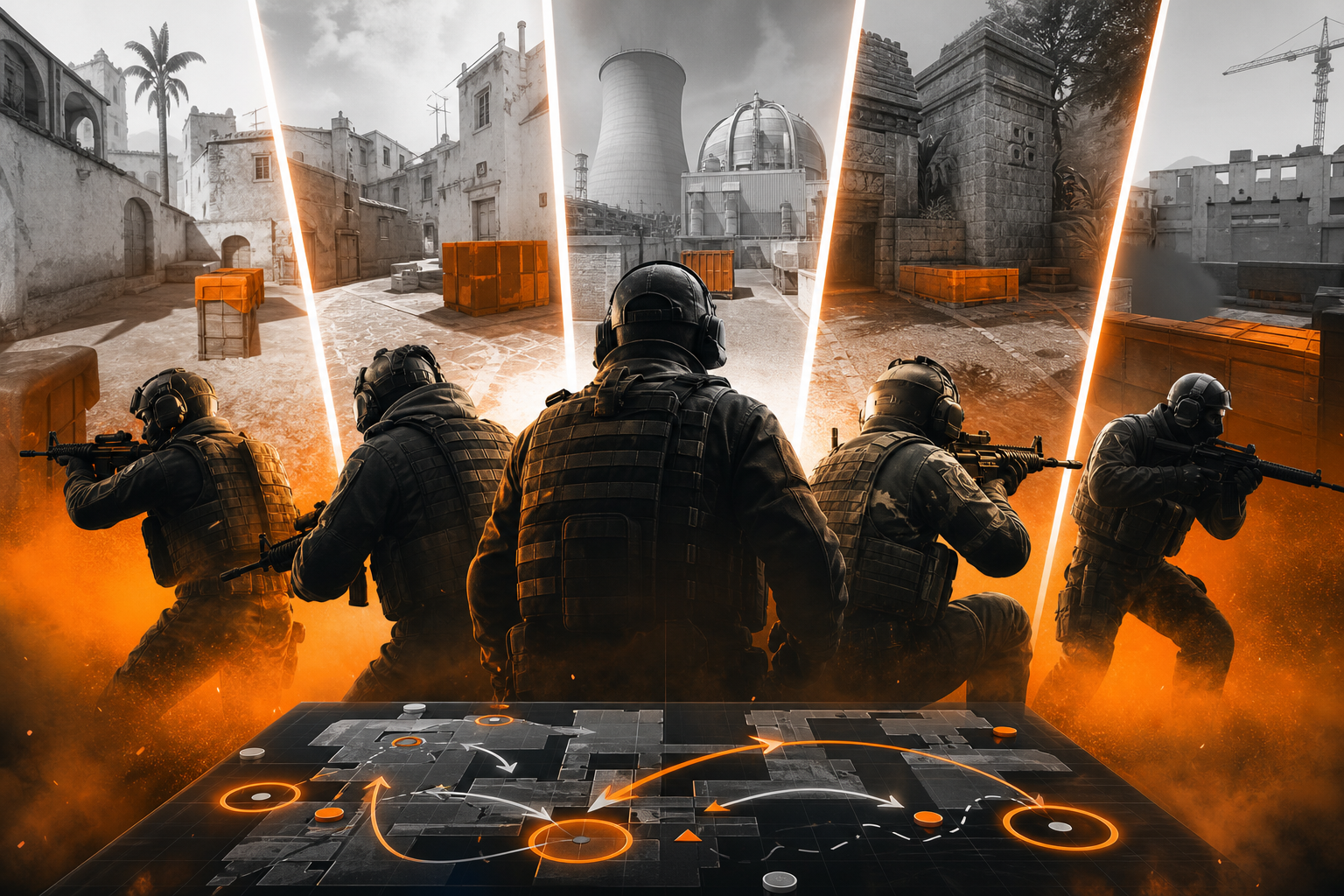
Unpredictable map pools make a team’s utility plan fragile: a lineup that works on a familiar layout may lose value when geometry, rotations, or the available maps change. Sharpening team utility timing for unpredictable map pools means building repeatable decision rules,not memorizing one fixed sequence,so players can adapt utility to the map, opponent, and round state.
The practical challenge is to preserve coordination while changing the details. That calls for a shared map-preparation process, clear timing cues, and deliberate review of what utility achieved. Recent VALORANT competition and Rainbow Six Siege rules illustrate why teams need both map-specific knowledge and protocols that remain useful when the pool shifts.
How to sharpen team utility timing for unpredictable map pools
Direct answer: Build a flexible utility plan around map geometry, team roles, and round objectives. Revalidate lineups after map changes, assign timing cues rather than fixed timestamps, track whether utility creates useful space or forces a response, and rehearse alternatives for when the opponent disrupts the default sequence.
That answer is simple; the work is in applying it consistently. A team needs enough map knowledge to make accurate choices, but not so many rigid instructions that one changed wall or delayed rotation breaks the whole round. The goal is to make the next decision legible to teammates even when the original plan no longer fits.
Think of a utility plan as three connected layers:
- Purpose: what the utility should accomplish, such as denying an area, clearing a position, protecting a plant, or enabling a retake.
- Trigger: the observable event that tells the team when to act, such as a teammate reaching a landmark, an opponent using a resource, or a rotation becoming available.
- Follow-up: who moves or uses the next resource after the first effect, and what the team does if the opponent does not react as expected.
This structure separates intent from execution. A lineup can change while the purpose remains useful; a timing cue can shift without forcing the team to invent a new round plan from scratch. Conversely, if the expected effect is absent, players have a clear reason to stop, re-evaluate, or move to a fallback instead of continuing a sequence that has lost its premise.
Separate map knowledge from utility protocols
Map knowledge is not a single category. Some information is stable enough to preserve across rounds, while other details need immediate revalidation after an update. Distinguishing the two helps teams avoid both extremes: treating every patch as a completely new map, or assuming that old lineups and timings remain valid after geometry changes.
Record what changes and what remains useful
A practical map file should identify the relevant geometry, common routes, important sightlines, and the team’s utility objectives. It should also identify which details are version-sensitive. In Rainbow Six Siege, the EML Challenger Circuit ruleset says Ubisoft may change the map pool and update map geometry at any point, sometimes with little or no prior notice. The rules also warn that updates can affect doors, walls, covers, bombsite locations, and other map features.
That warning has direct consequences for preparation. A targeted change may invalidate a throw, alter a line of sight, or change how long a team can safely occupy a route. The right response is not to assume that every setup is broken; it is to label the affected assumptions and test them again. A team can retain an objective and rebuild the method used to reach it.
For each map, separate notes into three working groups:
- Verified: lineups, routes, and timings that have been checked on the current version.
- Unverified: useful historical notes that still need testing after an update or pool change.
- Conditional: plans that are valid only when a particular geometry, opponent setup, or player role is present.
This simple distinction reduces accidental confidence. An old note is not necessarily wrong, but it should not be treated as current proof. Labeling it unverified tells the next practice group where to spend limited time and helps analysts explain why a familiar sequence behaved differently.
Keep protocols portable, not generic
A portable protocol is not a universal lineup. It is a decision rule that can be expressed on multiple maps without pretending that the maps are identical. For example, a team may define who confirms that a route is clear, who holds the next area, and what signal releases the follow-up. The exact ability, angle, and location still depend on the map and composition.
This distinction matters because map changes can alter the time available for a coordinated action. Riot has said that defender rotations on Corrode were taking too long, making retakes harder, and that its update addressed the issue. That is an example of geometry influencing the timing of utility and the coordination required after a plant. Teams should therefore test not only whether a lineup reaches its intended location, but whether its effect arrives at a useful moment in the updated round.
Useful preparation asks two questions separately: does the utility still function on this version of the map, and does the team still have enough time to act on its effect? The first is a mechanical check. The second is a team-timing check. Passing one does not guarantee the other.
Build timing around cues, not a memorized clock
Fixed timestamps can help a rehearsed sequence stay synchronized, but they are brittle when the round develops differently from practice. A delayed contact, an unexpected defensive response, or a changed route can make a time-based instruction arrive too early or too late. Cue-based timing gives players a shared trigger that is tied to what is happening rather than only to elapsed time.
Teams can use a small set of cue types and define them in plain language:
- Position cue: a teammate reaches a named area or confirms control of a route.
- Information cue: a player identifies a defender, a utility resource, or a relevant absence.
- Resource cue: an opponent uses a key piece of utility, creating a window to pressure or reposition.
- Round-state cue: the team has a clear objective, such as committing to a site, disengaging, or beginning a retake.
These cues are useful only when everyone interprets them the same way. A team should define who is allowed to call each trigger, what evidence is sufficient, and what the next action is. If several players use the same call to mean different things, the cue adds noise rather than coordination.
Use a primary sequence and a decision point
For a practiced execute or defensive response, identify a primary sequence and one explicit decision point. The sequence can describe the intended order of actions; the decision point marks where the team checks whether the conditions still support continuing. This avoids turning a rehearsed plan into an obligation to spend every resource after the situation has changed.
At the decision point, the caller can ask whether the expected space is available, whether the opponent has shown the anticipated response, and whether the team still has the players and utility needed to complete the objective. If the answer is no, use a rehearsed alternative: delay, rotate, hold the gained area, or stop the commitment. The precise options depend on the game and round, but the underlying discipline is transferable.
A useful timing plan answers not only when the first utility is used, but what evidence tells the team to continue, pause, or change the plan.
This does not mean replacing practice with constant discussion. The purpose of a cue is to reduce ambiguity during a live round. Rehearse the cue and its follow-up until players can act quickly, then review whether it was called on time and whether the team understood the same trigger.
Make utility efficiency visible in review
Teams often remember whether a round was won more readily than whether the utility sequence created the intended advantage. A useful review process separates outcome from process. A round can be won despite poor sequencing, and a well-executed plan can still lose because of an individual duel or an opponent’s strong response. Reviewing the utility’s job makes adaptation more precise than judging each use only by the scoreboard.
For each important utility action, ask a short set of questions:
- What was the intended effect, and did the team communicate it before acting?
- Did the utility create space, deny an area, force a response, or provide information?
- Did the next player act while that effect still mattered?
- Was the resource spent because the plan called for it, or because the player had no better cue?
- What changed when the opponent did not respond as expected?
These questions support practical changes. If an ability repeatedly arrives after the team has already passed the area it should affect, adjust the cue or sequence. If the action works but leaves the follow-up player too far away, change the role assignment or route. If the opponent repeatedly waits out the same pressure, vary the timing or hold the resource for a later decision.
Use data as a moving view of proficiency
Riot’s Patch 13.08 introduced a Map Rating system in which recent matches weigh more heavily than older ones. That is a useful signal for teams: map proficiency should be treated as something that can change, not as a permanent label attached to a roster. A strong historical record can provide context, but it does not prove that the current version, current lineup, or current opponent situation has been mastered.
Teams can apply the same principle internally without claiming that one metric captures the whole picture. Review recent map sessions alongside older material, and give current evidence greater weight when the map or team conditions have changed. Track observations that help make decisions: whether the opening plan is still effective, whether the team is arriving together, whether utility is forcing meaningful responses, and whether the fallback has been used successfully.
Riot also described Chamber adjustments in Patch 13.08 as changes that better reflect his utility use. This reinforces the value of evaluating utility more specifically than simply recording whether an agent appeared in a round. For team review, the practical question is not just who carried an ability, but whether the player’s use of it supported the round’s objective and whether the timing allowed teammates to capitalize.
Do not turn review into a demand for more utility usage. Efficiency can mean saving a resource, using it later, or choosing not to spend it when its effect will not help. The useful measure is the relationship between the resource, its purpose, and the team’s next action,not volume for its own sake.
Keep utility patterns difficult to read
A plan that works consistently can become recognizable. Repeating the same opening, route, and timing gives an opponent more opportunities to anticipate where the team will spend resources and when it will try to take space. A recent VLR profile comment argues that double-initiator styles can spend so much utility before fights that their map-control patterns become predictable and counterable. The point is not that a particular composition is inherently weak; it is that a powerful sequence can lose value when its timing and purpose are too easy to read.
Variation should preserve team coordination rather than create randomness. Teams can vary one element at a time: the timing of an action, the order of two resources, the route used to establish pressure, or whether an early effect is followed by an immediate commitment. Keeping most of the protocol stable helps players execute, while changing a meaningful element makes the opponent reassess its response.
Vary the question the utility asks
Instead of treating each round as a different set of buttons, frame variation as a different problem for the defense. One round might ask whether the opponent will spend a resource to contest an area. Another might hold the same threat without committing, testing whether the opponent over-rotates. A third might use the initial utility to create space for information or repositioning rather than an immediate fight.
This approach makes the team’s utility harder to counter without requiring every round to be a new invention. Players share the same language for the action, but the intended outcome can change. The caller should communicate that outcome clearly, because an opponent-facing variation that confuses the team is not a useful variation.
Variation also has limits. If players change several parts of an execute at once, review becomes difficult: the team may not know which change improved the result or caused the failure. Introduce changes deliberately, keep track of what was altered, and return to the stable version when execution quality falls below what the team can support.
Strong fundamentals remain the foundation. VLR commentary has connected good utility usage with sound fundamentals, and coverage of EDG versus DRG described layered utility being used to pressure Cypher setups on a map that had been a sore spot for EDG since the start of the 2025 season. Those examples point to the value of timing and coordination on unfamiliar or difficult maps; they do not establish that a particular lineup or sequence will work everywhere.
Prepare for pool changes and compressed decision windows
Unpredictability comes from more than map updates. Teams may face a new or altered map with little practice time, and tournament procedures can compress the time available for choosing maps or adjusting plans. Preparation must therefore cover both the map itself and the process by which the map enters the match.
In VALORANT, VLR’s coverage of Grubinho describes the 2026 start as involving a shorter offseason, a new Sentinel Veto, and significant gameplay changes to utility. Grubinho noted that Breeze had changed substantially and that teams were still learning how to play it ideally. The same report discusses Corrode and the updated Breeze as changes that teams had to adapt to quickly, while competitive play limited how much they could learn from other regions on the fly.
That situation makes a full, polished playbook an unrealistic requirement for every map. A better priority is to establish minimum viable preparation: confirm the current geometry, identify the most important routes and objectives, assign a small number of roles, and rehearse a fallback. Then use match and practice evidence to refine the plan. Teams should distinguish a temporary working answer from a fully validated setup so that early confidence does not become false certainty.
Account for veto structure before the map is locked
Map-ban systems are part of the competitive timing game. The Six Invitational 2026 rulebook describes a structured ban and pick order, a coinflip for veto control, and a map order based on the maps selected. It also gives each team four minutes per veto step. Those constraints reward advance preparation: teams have little room to improvise an entire map plan while the veto is underway.
Prepare for the decision, not just the final map. Teams can identify which maps are ready for a complete plan, which have only a fallback-level plan, and which carry known preparation risks. The veto caller should have a clear view of those trade-offs before the process begins. This does not remove uncertainty, but it ensures the team understands what it is accepting when a less familiar map remains in the pool.
Rainbow Six Siege shows a related but distinct pattern. The Six Invitational 2026 rulebook lists a nine-map pool for that event, providing an event-specific pool. The EML Challenger Circuit ruleset, meanwhile, says Ubisoft may modify the pool or map geometry during the season. Event stability and seasonal volatility can therefore coexist: a team may prepare against a defined set for one competition while still needing a process for changes elsewhere in the season.
Make the distinction explicit in the preparation schedule. For an event with a listed pool, verify the event’s rules and prepare for its permitted maps. For season-long work, maintain a method for checking updates and revalidating affected setups. Do not assume that a fixed pool for one event means the broader competitive environment is fixed.
Rehearse fallback plans and use pauses correctly
A fallback is not an admission that the primary plan is weak. It is a way to keep the team coordinated when the expected opening is denied or the map conditions make the original timing unsafe. Without a fallback, players may continue spending resources to rescue a plan that no longer has its necessary conditions, or they may split into separate ideas with no shared objective.
For each important plan, define a small number of branches. A branch might preserve the objective but change the route, or preserve the gained space while postponing the commitment. State the trigger for switching, the player responsible for the call, and what happens to the remaining utility. Keep branches limited enough that the team can rehearse them under realistic time constraints.
Timeouts can support communication, but they do not solve a timing problem by themselves. The ACE VALORANT Challengers 2026 ruleset says timeouts last 60 seconds, with only two per map in regulation. It also says players cannot move or use utility during a timeout. The rules further constrain the call to the first 20 seconds of a buy phase; otherwise, the timeout is deferred.
Those rules make preparation before the pause essential. Players cannot use the timeout to test an in-round lineup or repair a live utility sequence. Instead, teams should use the available window to agree on a specific adjustment: what cue changes, which resource is held or reassigned, and what the team will do if the opponent repeats the same response. Because the call must fit within a limited window, a concise shared vocabulary is more useful than a long explanation of the entire map.
Make the next-round instruction executable
A good timeout instruction should be possible to remember and act on. It should name the observed problem, the change, and the trigger for applying it. For example, the team might decide to delay a planned follow-up until a teammate confirms control of a route, rather than repeating the same sequence at the same moment. The exact call will depend on the match; the general standard is that all players can state what changes in the next round.
After the timeout, review whether the team followed the adjustment, not only whether the round was won. If the instruction was unclear or too broad, simplify it for the next pause. If the team executed it but the opponent adapted, update the next decision. The pause is a scarce coordination opportunity, so its value comes from translating analysis into a precise action.
Run map practice as a repeatable validation loop
When the pool is unstable, practice should produce both execution and reliable notes. A useful session does not need to cover every possible map contingency. It should test the most important assumptions, expose failures early, and leave behind an update that another practice group can understand.
Use a short validation loop:
- Check the version: confirm the map and relevant rules or update information before testing old notes.
- Choose a question: identify one timing or utility assumption to test, such as whether the sequence creates space before the team needs to cross.
- Rehearse the cue: practice the trigger and the immediate follow-up, including who calls and who acts.
- Test a disruption: have the practice opponent delay, deny, or respond differently so the team must recognize when the original plan no longer applies.
- Record the result: mark the plan as verified, conditional, or unverified and write down the next adjustment.
This loop helps keep practice focused. Testing one question at a time makes the result easier to interpret, while a disruption test checks whether players understand the plan’s purpose instead of merely remembering a sequence. The record should be concise enough to maintain, but detailed enough to preserve the trigger, intended effect, and relevant map-version assumption.
Prioritize practice when time is limited
Not every map deserves equal practice in every preparation window. Prioritize according to the team’s exposure, uncertainty, and the consequences of being wrong. A newly changed map or an unfamiliar map that may enter the veto can justify validation before a comfortable map whose key setups have recently worked. A map with a known geometry change should receive targeted checks on affected routes and timings rather than an automatic full reset.
Practice quality also depends on the realism of the opposing response. If a setup only succeeds when defenders behave exactly as expected, it is not yet a flexible protocol. Ask practice partners to challenge the timing or refuse the expected fight. The purpose is not to imitate every possible opponent; it is to find out whether the team has a clear next action when its first read is wrong.
Finally, keep the notes operational. Avoid recording conclusions such as a map is comfortable or an execute feels good without a reason players can act on. Better notes identify the cue, the effect, the follow-up, and the condition that invalidates the sequence. This makes a plan easier to transfer between players and easier to update after a patch.
What strong adaptation looks like in competition
Adaptation is visible in the relationship between information and action. A team that notices a changed rotation but continues to use an old timing has not fully adapted. A team that changes every utility sequence without testing the result may also be reacting rather than learning. Strong adaptation preserves a stable objective while updating the details that the current map and opponent demand.
Look for several signs in review. Players can explain why a resource was used, not just which ability was used. The next action follows while the effect remains relevant. The team can stop or branch when a cue is absent. On a changed map, players know which notes have been revalidated and which are still assumptions. Across rounds, the team varies its pressure without losing its shared vocabulary.
Map familiarity should also be treated as distinct from roster strength or individual mechanics. VLR’s EDG versus DRG coverage describes a map remaining a sore spot for EDG across time, despite the team’s ability to use layered utility to pressure Cypher setups. The example underlines a practical limit: one successful sequence does not automatically erase a map-specific weakness. Familiarity and timing precision need to be rebuilt through repeated, current-version practice.
At the same time, teams should avoid overfitting to one match. A successful utility sequence may have benefited from an opponent’s particular setup, and a failed sequence may still have been the correct choice under the information available. Review should identify whether the decision was sound at the time, whether the execution matched the plan, and what new information the result provides. This keeps adaptation grounded instead of turning every outcome into an instruction to copy or abandon a strategy.
The most durable advantage is not a perfect lineup library. It is a team process that can absorb a map update, a veto surprise, or an opponent’s counter without losing coordination. When players know the purpose of each utility action, share clear timing cues, and keep current evidence a of stale assumptions, unfamiliar maps become manageable problems rather than reasons to improvise blindly.
For the next practice block, choose one map whose geometry or pool status may change your preparation. Verify the map, test one important utility timing, rehearse the fallback, and update the team’s notes before the next match. Repeat that cycle whenever the evidence changes, and treat every plan as current only for the conditions under which it has been checked.
Leave a Reply