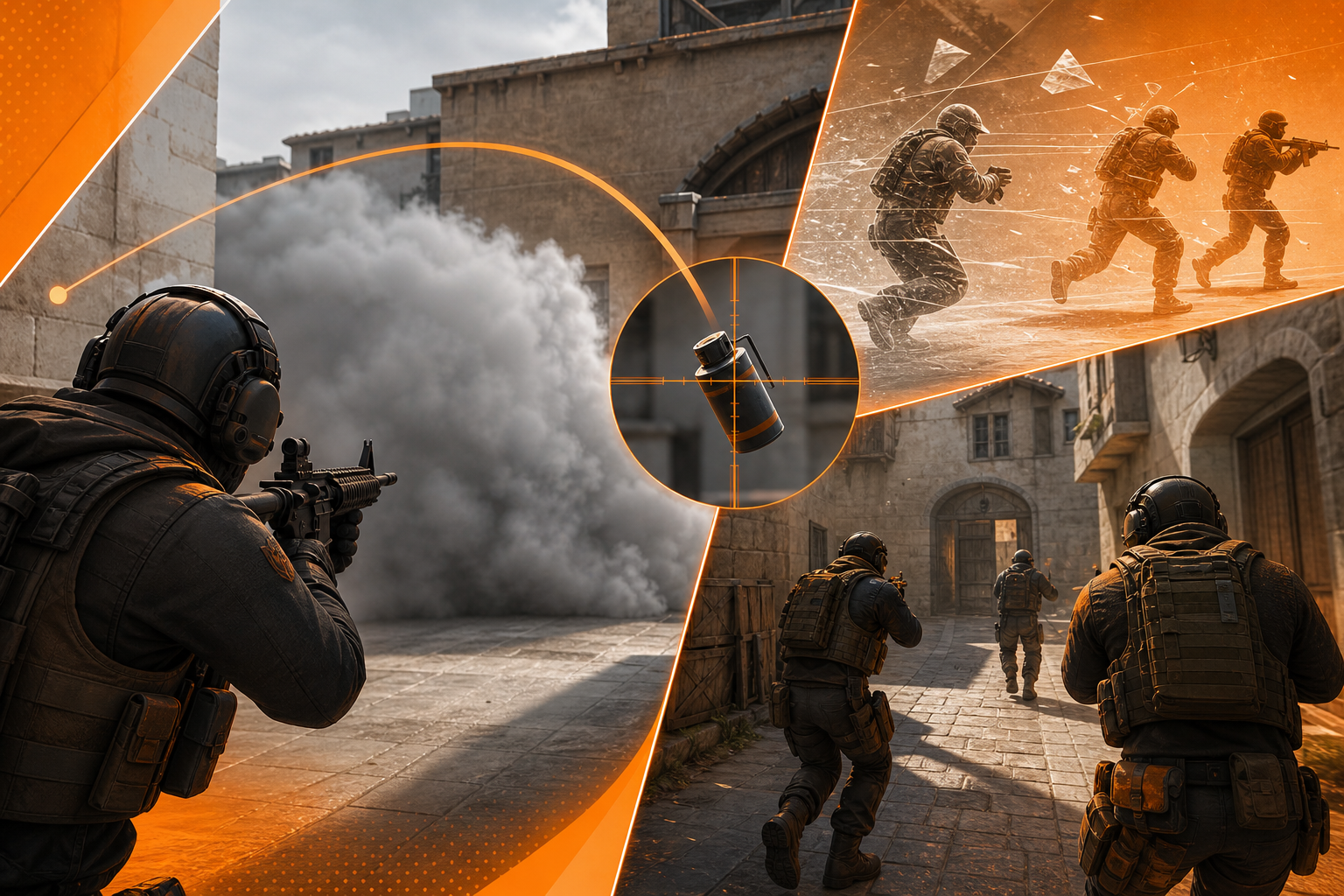
Coordinated CS2 utility now depends on more than memorizing a lineup: dynamic smokes respond to the game environment, while freeze-time grenade crosshairs give players a visual aid for preparing insta-smokes before the round begins. For teams, the practical opportunity is to make executes more repeatable through shared preparation and timing; the limit is that crosshair help cannot remove the need to communicate, adapt, and verify utility in the live round.
Dynamic smokes and freeze-time grenade crosshairs are reshaping coordinated teamplay by shifting part of the work from mid-round improvisation into a planned, testable team protocol. This guide explains what the changes do, how to standardize them across players, and how to build a utility routine that remains useful when a round does not follow the script.
How dynamic smokes and freeze-time grenade crosshairs change teamplay
Direct answer: Dynamic smokes react to the environment, lighting, gunfire, and explosions, so teams need to coordinate smoke timing and follow-up actions rather than treat each smoke as a fixed visual screen. Freeze-time grenade crosshairs let players hold a grenade attack button and line up an insta-smoke with visual assistance before the round starts. Together, these changes make planned, shared utility routines more practical, but they do not replace communication or in-round adaptation.
The important shift is from treating a smoke as a static item in a utility list to treating it as one part of a sequence. A team still needs to decide who throws, where the throw is intended to land, when it should happen, and what teammates do while the smoke is active. Because CS2’s smoke grenades are dynamic volumetric objects, Valve says they react to the environment, lighting, gunfire, and explosions. Those interactions make it more important to synchronize the sequence around the smoke, not simply to reproduce a familiar throw.
Freeze-time grenade crosshairs address a different part of that workflow. Valve’s September 30, 2026 update made grenade crosshairs in freeze time for insta-smokes official. Players can hold any grenade attack button during freeze time to line up utility with visual crosshair help before the round begins. This makes preparation available during a team’s existing pre-round window; it does not make the throw itself automatic or tell the rest of the team how to use it.
Keep the distinction clear when building a team standard. Dynamic smoke behavior is a game-system change affecting what happens after a grenade is thrown. Freeze-time grenade crosshairs are a preparation aid for aligning a throw. The two can reinforce each other, but they solve separate problems: one affects the utility’s in-game behavior, and the other supports repeatable setup.
- Before the round: identify the thrower, lineup, target, and intended timing.
- During the round: call the throw and coordinate the actions that depend on the smoke.
- After the throw: read the actual situation rather than assuming the smoke will behave like a fixed, unchanging wall.
That framework is useful for both set-piece executes and defensive utility. It gives players a common reference without confusing a visual aid with a complete tactical solution. The result can be less improvisation at the point of execution, provided the team also practices what to do when the intended sequence is disrupted.
Why dynamic smoke grenades require timing, not just memorized lineups
In CS2, smoke grenades are described on the official game page as dynamic volumetric objects that react to the environment, lighting, gunfire, and explosions. That description matters tactically because it means a smoke is not only a coordinate on a map. It is also an object interacting with the conditions around it. Valve’s stated behavior supports a more timing-conscious approach to coordinated executes than a simple “throw smoke, then proceed” script.
That does not mean teams should abandon lineups. A practiced lineup remains a way to make a throw more consistent. Instead, teams should connect the lineup to a decision: what action is the smoke meant to enable, and what should the team do if its visual or tactical effect changes during the sequence? The more dependent a play is on a particular sightline being covered, the more important it becomes to coordinate the next action around the smoke’s actual state.
Plan the sequence around the smoke’s purpose
A useful smoke call contains more than a location. It identifies the thrower and the intended moment, then tells teammates what they are waiting for. For example, a team can define a practice scenario in which one player lines up a smoke during freeze time, communicates readiness, and throws on the team’s agreed cue. Teammates then act on the call and confirm what they can see. This is a practice structure, not a claim that every map or execute should use the same timing.
Where gunfire or explosions are part of a planned sequence, the team should consider their relationship to the smoke rather than assume those events are irrelevant. Valve identifies both as factors to which smoke grenades react. Teams can therefore review whether the order of utility and engagement is serving the plan. The right answer depends on the situation and should be verified in practice; the patch information does not prescribe one universal order.
Separate repeatability from certainty
A repeatable throw is not the same as a guaranteed outcome. A lineup can help a player reproduce the setup, while the dynamic nature of the smoke means the team still needs to observe the result. This distinction prevents a common planning error: treating a rehearsed input as proof that every teammate will receive exactly the same tactical opening in every round.
In review, label these two questions separately:
- Execution: did the intended player reproduce the lineup and throw?
- Outcome: did the smoke support the team’s intended movement and sightline plan in the conditions of that round?
If execution was correct but the outcome did not support the plan, the answer may be to adjust timing or the follow-up rather than discard the lineup. If the throw itself was inconsistent, review the setup and crosshair standard first. Separating those causes gives teams a more useful diagnosis than simply marking a smoke as “good” or “bad.”
Use freeze time to prepare insta-smokes without rushing the call
Freeze time is a coordination window, not just a pause before action. Valve’s September 30, 2026 update added grenade crosshairs in freeze time for insta-smokes, allowing players to hold any grenade attack button and line up utility with visual crosshair help before the round starts. Competitive rulebooks in 2025 and 2026 continue to allow tactical timeouts that extend freeze time, reinforcing the role of this period as a space for team planning. The exact rules still depend on the competition, so teams and organizers should check the applicable rulebook rather than assume every event handles timeouts identically.
For a team, the feature is most useful when it is folded into a short, consistent pre-round routine. A player can prepare the throw while the caller confirms the plan, but the rest of the team still needs to know what the lineup is for. If everyone uses the freeze-time window to make separate, unannounced adjustments, the new visual aid may improve individual setup without improving collective coordination.
A practical freeze-time sequence
- Confirm the plan. The caller identifies the intended utility, the player responsible, and the action the throw is meant to support.
- Prepare the lineup. The assigned player uses the freeze-time grenade crosshair to align the insta-smoke, following the team’s practiced setup.
- Make readiness explicit. The thrower confirms that the setup is ready. Teammates should not infer readiness simply because a player is holding a grenade.
- Set the trigger. The caller gives a clear cue for the throw or for the team’s next action, consistent with the round plan.
- Reassess after release. Once the smoke is in play, players communicate what they observe and adapt if the round has changed.
This routine reduces ambiguity without requiring a long pre-round speech. It also makes the feature usable by teams with different communication styles: the essential requirements are a shared purpose, an assigned thrower, a readiness signal, and an agreed trigger. Teams can simplify or expand the calls, but those responsibilities should not be left implicit.
Use freeze time to remove uncertainty about who is preparing the smoke and when the team will act; do not mistake a prepared crosshair for a complete execute call.
For coaches and analysts, the routine creates reviewable checkpoints. If the team misses its timing, ask whether the lineup was ready, whether readiness was communicated, and whether the trigger was clear. That is more actionable than blaming the smoke or the player after a rushed attempt. It also helps teams distinguish setup friction from a tactical decision that simply needs revision.
Standardize CS2 crosshair settings for repeatable team utility
Crosshair configuration has become a team operations question as well as a personal preference. Valve’s September 23, 2026 update made crosshairs resolution independent and explained that thickness, length, and gap are now defined in pixels rather than an arbitrary scale. Valve also updated crosshair share codes to include scope dot scale and color preferences. These changes make it easier for teams to reproduce settings and discuss them precisely across player setups.
Resolution independence is useful for standardization, but it should not be oversold. It makes settings more consistent across different displays and player setups; it does not mean every display will look identical, or that a shared code makes every player’s visual perception identical. Teams should verify the configuration on the actual setups used for practice and competition, especially where readability is a concern.
Separate utility aids from weapon-accuracy feedback
Several 2026 updates expanded an ecosystem of dynamic crosshair options. Valve said the new dynamic crosshair styles show real weapon spread and inaccuracy, and that “Dynamic Spread Limit” caps how far the crosshair can expand at maximum inaccuracy. The September 23 update also changed the default crosshair to “Dynamic Quad,” which Valve described as better representing weapon accuracy. Later in September, Valve added “Static Quadrant,” outline color options, and updates to share-code formatting for new settings. On September 30, Valve refined classic dynamic crosshair tuning by allowing negative gaps and changing alpha increments to 0.01.
These details matter because not all crosshair functions serve the same purpose. A crosshair that conveys weapon spread and inaccuracy can help a player interpret weapon behavior; the freeze-time grenade crosshair feature helps with lining up insta-smokes. Teams should avoid assuming that choosing a dynamic weapon crosshair automatically standardizes grenade practice. Instead, document which settings are required for the team’s shared workflow and which remain individual comfort choices.
Build a minimum team standard
A robust configuration policy specifies only what the team needs to reproduce. Too little standardization can make shared instructions vague; too much can impose settings that do not help a given player. A practical policy can include:
- A reference share code for the agreed crosshair settings, including the preferences supported in the updated code format.
- A named profile or written record of the settings the team relies on for utility practice, so staff can identify the intended configuration.
- A verification step after a player changes resolution, display, or configuration, to confirm the relevant settings remain readable.
- A clear boundary between required team settings and optional personal preferences, particularly for appearance choices that do not affect the shared lineup protocol.
Because Valve now defines thickness, length, and gap in pixels, staff can describe settings with more concrete values than an arbitrary scale. That helps a coach or analyst compare setups and communicate changes. It does not establish that one particular thickness, gap, color, or dynamic style is best for every player; the team should test readability and utility consistency rather than copy a setting without review.
Turn a lineup into a coordinated execute protocol
A lineup becomes team utility only when the rest of the roster knows how it fits into the round. The same prepared smoke can be useful or mistimed depending on whether teammates understand the cue, their roles, and the intended follow-up. Dynamic smoke behavior strengthens the case for rehearsing that full sequence, while freeze-time crosshairs make the setup stage more visible and repeatable.
Document the call in operational terms
Keep the team’s lineup record short enough to use during practice. A useful entry can state the player responsible, the purpose of the smoke, the preparation method, the readiness call, the throw trigger, and the planned team response. Avoid relying on a bare location label. A name or shorthand might help the team remember a setup, but it does not tell a substitute player or a new teammate when to use it.
For example, a practice record could describe an illustrative sequence without claiming it applies to a specific map: the assigned player prepares an insta-smoke during freeze time; the caller confirms the team’s intended timing; the thrower signals readiness; the caller gives the cue; teammates proceed according to the rehearsed plan and report what the smoke actually enables. The value of this example is its role clarity, not any particular angle or result.
Assign ownership, not just a grenade
One player should own the throw, but the team should own the outcome. The thrower is responsible for preparing and executing the utility according to the agreed method. The caller is responsible for setting the timing and confirming the team’s next action. Other players should know whether they are waiting, moving, or providing another part of the utility sequence. Those responsibilities can be combined in smaller teams, but they should be explicit.
Assigning ownership also helps when a round changes. If the designated thrower is interrupted or the team abandons its original plan, someone needs to communicate the adjustment. A protocol that only works when every event occurs in order is brittle. A better one includes a simple cancellation or adaptation call, so players do not continue a stale plan just because the lineup was prepared in freeze time.
Teams can review the protocol with a small set of questions:
- Was the intended thrower clear to every player?
- Did the thrower and caller agree on the readiness signal and trigger?
- Did teammates understand what action the smoke was intended to enable?
- Did the team respond to the smoke that actually appeared, rather than the one it expected?
These checks keep review focused on coordination. They also prevent teams from turning every failed execute into a mechanical complaint about a crosshair or lineup. Sometimes the setup is wrong; sometimes the timing is unclear; sometimes the team needs a different response. A structured review makes those possibilities easier to distinguish.
Practice and validate utility after updates to smokes and map geometry
Repeatable utility depends on more than the player’s crosshair. Valve has continued to patch smoke and molotov interaction logic, including fixes for cases involving multiple active smokes. Valve has also made grenade clipping and map geometry changes in several 2026 updates. Those changes matter to teams because clipping and geometry directly affect the consistency of pre-planned utility lineups. A lineup that worked under an earlier version should be treated as something to verify after relevant changes, not as permanent documentation.
Valve has explicitly encouraged community utility learning. In a March 18, 2026 CS2 post, the company pointed players toward Workshop Maps and noted that players can learn smokes offline. Teams can use that kind of practice environment to learn and rehearse utility without treating a live competitive round as their first test. The precise practice method will vary, but the principle is simple: validate the intended setup and then rehearse the team call around it.
Use a repeatable validation loop
- Confirm the configuration. Check the relevant crosshair settings and share code before testing the lineup.
- Reproduce the setup. Have the assigned player prepare the throw using the team’s documented method, including freeze-time grenade crosshairs where appropriate.
- Test the intended utility. Observe the result in a suitable practice environment, including the team’s intended timing and any relevant interaction with other utility.
- Record what changed. If the setup or expected outcome differs from the team’s record, update the documentation rather than relying on memory.
- Rehearse the team response. Test the call, cue, and follow-up together so the lineup is not validated only as an isolated throw.
When a smoke-related patch or geometry change is relevant to a team’s playbook, staff can prioritize the lineups that the team uses most or that rely on precise clipping. This is a sensible maintenance practice, not a claim that every update invalidates every lineup. The key is to avoid assuming that a familiar setup is unchanged when the game has altered a relevant interaction or piece of geometry.
Record the version or practice context alongside a lineup update if that helps the staff track what was verified. Keep the record factual: what was tested, who confirmed it, and whether the team needs another review. Do not treat one successful repetition as proof of universal reliability. Repetition is valuable because it reveals whether the player can reproduce the setup and whether the team can use the smoke as intended.
This validation loop is also useful for roster changes. A substitute may understand the tactical purpose but not have the same familiarity with a particular setup. A shared code and written protocol lower the amount of information that must be transmitted verbally, while practice confirms the player can execute it. The standard should make onboarding easier without promising identical outcomes from every player in every round.
Account for latency, communication, and tournament operations
For competitive teams and technical staff, a more repeatable lineup does not eliminate the operational need for reliable communication. Crosshair settings and grenade preparation help standardize the player’s visual setup, but the team still has to exchange readiness and timing information. A lineup cannot tell a teammate that the round plan has changed, and it cannot substitute for the caller’s decision about when to proceed.
That distinction is especially useful when teams review their practice environment. Treat the crosshair and lineup as one part of the setup, and the communication path as another. If a call is missed or delayed, first identify where the coordination broke down rather than assuming the game feature failed. Teams can rehearse concise calls and confirm that players know the signal conventions they are expected to use. Any technical investigation should be based on the actual match or practice environment, not on assumptions that a crosshair change itself improves network performance.
Separate player configuration from server behavior
The updates described here affect crosshair options, freeze-time utility preparation, smoke behavior, and related game interactions. They do not, on their own, establish a particular change to hosting, server tick behavior, latency, or match stability. Platform engineers should keep those categories separate when diagnosing an issue. A player-side settings problem, a lineup affected by map geometry, and a server or network problem require different evidence and different remedies.
For a hosted practice session, technical staff can keep a concise operational checklist:
- Confirm players are using the intended game version and shared crosshair configuration.
- Ensure the practice scenario gives the team time to rehearse its freeze-time calls and utility sequence.
- Capture the relevant round context when a team reports an inconsistent smoke or a missed timing.
- Distinguish a visual setup discrepancy from a communication issue or a broader service problem before changing infrastructure.
These are diagnostic practices, not claims that a specific hosting architecture changes smoke physics or crosshair behavior. Their value is in keeping the review disciplined. If the lineup is inconsistent across repeated tests, verify the player setup and game interaction first. If the lineup is sound but the team acts at different times, review the call structure. If there is evidence of a service or connectivity issue, investigate that separately.
Competition organizers have a related responsibility: communicate the applicable rules for tactical timeouts and freeze-time procedures. Tournament rulebooks in 2025 and 2026 continue to allow tactical timeouts that extend freeze time, but the event’s own rulebook governs its format. Teams should understand how the event applies those rules, and organizers should make the procedure clear enough that players can plan within the allowed window. The new crosshair aid is most useful when players know what preparation is permitted and have enough shared time to coordinate the plan.
Know the limits: visual assistance is not tactical automation
The new tools improve the conditions for coordination, but they do not automate the hard parts of teamplay. A freeze-time grenade crosshair helps a player line up an insta-smoke; it does not choose a good tactical moment, confirm that teammates are ready, or decide whether the round should continue after circumstances change. Dynamic smokes add interaction with the environment, lighting, gunfire, and explosions; they do not tell the team how to respond to what happens next.
Crosshair standardization also has a boundary. Resolution-independent settings and pixel-based thickness, length, and gap values make configuration more reproducible. Share codes that include scope dot scale and color preferences improve the ability to pass settings between players. But reproducible configuration is not identical to identical perception. A team should make settings easy to share while leaving room to confirm that each player can read them comfortably on the setup they actually use.
There is also a trade-off between scripted reliability and responsiveness. A practiced execute can reduce hesitation and make roles clear, but a rigid script can fail when the throw is delayed, utility behaves differently than expected, or the team’s opening changes. The answer is not to stop scripting; it is to define the purpose of the script and teach players the conditions under which they should adapt or cancel it.
Use a small set of principles to keep the protocol useful:
- Standardize the mechanics that benefit from repetition, such as the assigned thrower and the shared lineup reference.
- Keep the tactical decision in the team’s hands, including the timing and whether to proceed.
- Review the actual outcome, not only whether the crosshair looked correct before the throw.
- Retest relevant setups when game changes affect smoke logic or map geometry.
These limits should not be read as a reason to ignore the updates. They describe where the tools fit. The more clearly a team separates visual preparation, grenade execution, communication, and tactical judgment, the easier it is to improve one layer without expecting it to solve all the others.
Dynamic smokes and freeze-time grenade crosshairs make coordinated utility more amenable to shared preparation: teams can standardize a setup, rehearse a timing call, and review whether the resulting smoke supported the intended action. The strongest payoff comes when players treat the crosshair as a preparation aid, the smoke as a changing in-game object, and the execute as a team decision that must remain responsive.
For team leaders, analysts, and technical staff, the next step is practical: select the lineups that matter most, document the player and timing responsibilities, share a verified crosshair configuration, and rehearse the full call-and-response in practice. Recheck affected lineups after relevant smoke or geometry updates, and keep the team’s protocol clear enough to adapt when a round stops following the plan.
Leave a Reply